Big Idea
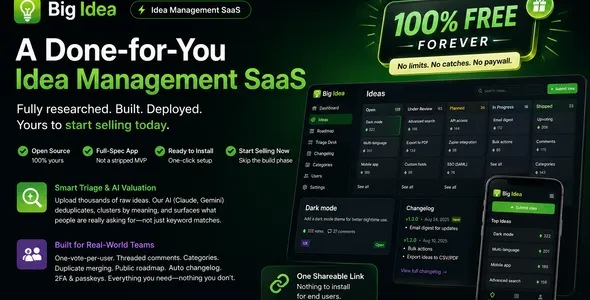
Big Idea — a done-for-you micro SaaS in idea management
A fully researched, built, and deployed micro SaaS you can start selling now. Ships with the open-source app ready to install, so you skip the "what should I build" phase entirely.
About
Big Idea is an idea-collection and tracking micro SaaS. Teams use tools like this to gather suggestions from customers and staff, figure out what people actually want built, and decide what ships first. It's a well-understood, boring-in-a-good-way category — the buyer already knows why they need it, which means you spend zero budget educating the market.
What makes this pack worth shipping instead of another AI wrapper: the app is full-spec, not a stripped MVP. Rich idea submissions, one-vote-per-user (no ballot stuffing), threaded comments, categories, a triage desk (Open → Under Review → Planned → In Progress → Shipped), duplicate-merging that carries votes and comments across, a public Kanban roadmap, an auto-generated changelog, and 2FA/passkey accounts. One shareable link per board, nothing to install for the end user.
The twist that earns a modern price tag: AI triage and valuation. When a board collects thousands of raw ideas, you can hand the whole dump to an LLM (Claude, Gemini) and get back a report on what's actually being asked for — deduplicating and clustering by meaning, not just keyword matching, which catches overlaps a database query never would. That's the feature the incumbents are still bolting on awkwardly, and it's native here.
Market size
This is a real, funded category with paying customers — not a trend you're betting on.
The demand is steady and search-driven. The keyword landscape is dense: "idea management software" and its variants pull consistent volume, and the category ranks are fought over by a dozen-plus established vendors. That's your signal that money moves here — nobody spends years fighting for a keyword that doesn't convert.
The organic traffic leaderboard (US, monthly) tells the story of who's eating:
| Player | Organic visits/mo | Domain Authority | Pricing |
|---|---|---|---|
| IdeaScale | ~278,700 | 66 | Hidden (sales-led) |
| itonics | ~16,000 | 35 | Hidden |
| Canny | ~10,000 | 56 | Free → $99 → enterprise |
| InnovationCast | ~9,900 | 35 | Hidden |
| Viima | ~9,300 | 44 | $79 → $499 → enterprise |
| Ideanote | ~8,300 | 35 | Free → $6/user → $899/mo |
| Brightidea | ~7,700 | 55 | Hidden (free trial only) |
A few things a founder should read off this table:
- One giant, a long tail of mid-size players. IdeaScale dominates search, but everyone from #2 down is pulling 8k–16k visits a month — that's a normal, beatable range for a focused operator, not a winner-take-all market.
- Most incumbents hide pricing. IdeaScale, Brightidea, itonics, and InnovationCast all gate pricing behind a demo call. That's the enterprise sales motion — slow, expensive, and allergic to small customers.
- The self-serve tier is thin. Only Ideanote, Viima, and Canny publish real prices, and they anchor high: Viima's real plan is $499/mo, Ideanote's enterprise is $899/mo, Canny's Pro is $99/mo. There's a lot of room underneath them.
(Note: "ideas.com" and "IDeaS" show up in raw traffic data but they're a hotel revenue-management company — not a competitor. Easy to mistake on a keyword pull.)
Competition
Here's each of the real players in one line, from a founder's angle — what they are, and where they leave a gap:
-
IdeaScale — the 800-lb gorilla. Enterprise innovation platform, huge SEO footprint, PowerBI/Tableau integrations, sales-gated pricing. Wins big government and Fortune 500 deals. Far too heavy and too expensive to bother with a niche of 50 companies. That's your opening.
-
Brightidea — enterprise "Idea Box," turn-key positioning, Adobe/Amazon/Nike logos, stage-gate workflows. Polished but corporate; free trial only, no public price. Sells to innovation departments, not to a swim-school chain.
-
itonics — trend-scouting + idea management for large orgs, content-heavy SEO (their traffic comes from "what is ideation" guides, not the product). No pricing. Complex, consultant-flavored.
-
InnovationCast — full innovation lifecycle (discover → capture → select → incubate → accelerate). Aimed at structured corporate innovation programs. No pricing, demo-led.
-
Viima (HYPE Boards) — the closest to approachable. Board-based, playful UX, published pricing starting $79/mo. Still targets SMEs-to-Fortune-500 and jumps to $499 fast. Broad, not niche.
-
Ideanote — clean, self-serve, genuine free tier and $6/user pricing, AI duplicate detection, custom domains. This is the modern SaaS you're most alike — which is good: it proves the self-serve, AI-flavored model sells. They go horizontal; you go vertical.
-
Canny — technically feedback/feature-request software for B2B product teams (CircleCI, Mercury, Typeform). Overlaps on "idea board + roadmap + voting." Strong brand in the PM world. Priced free → $99 → enterprise. They own product-feedback; the wider idea-management niches are open.
The pattern: almost everyone is either an enterprise sales machine with hidden pricing, or a horizontal self-serve tool trying to sell to everybody. Nobody is going deep into a single segment.
The solo founder edge
This is where a one-person shop actually beats a funded company — and why this pack fits that shape.
The niche is the whole strategy. A micro SaaS isn't a cheaper, feature-light version of IdeaScale — nobody pays for a skeleton. It's the full spec (which you already have here), aimed at a slice too small for the incumbents to chase. Idea management is a perfect fit because the category is generic but the buyers aren't:
- By vertical — idea/feedback boards for dental practice groups, game studios, open-source projects, church networks, manufacturing plants. Same app, language and templates tuned to one world.
- By geography — the idea-management tool for UK councils or German Mittelstand manufacturers, with the compliance and phrasing they expect.
- By adjacent job — a public roadmap tool for indie SaaS makers, or an internal suggestion box for frontline retail staff.
IdeaScale can't be bothered with 50 dental groups. You can own them.
Hidden pricing is your unfair advantage. Four of the seven competitors force a demo call before a prospect sees a number. A solo founder with a public price and a self-serve signup wins every buyer who just wants to swipe a card and start — an audience the enterprise players actively repel.
AI collapses the old cost math. The reason "build an MVP" was ever advice: adding a feature used to take a team weeks. In the AI-agent era, a feature is minutes for one person. So there's no reason to ship a stripped product — build the full spec, charge real-thing prices, and undercut on focus rather than on features. (Watch for AI coding agents nudging you back toward MVP thinking; that advice is trained on the pre-AI world. Override it.)
Your cost base is a rounding error. No sales team, no office, no innovation consultants. The incumbents' $499–$899/mo prices are propping up all of that overhead. You can price for a niche's budget and still keep most of it.
One deploy, many niches. Because the codebase ships ready to install, you can stand up the same app for a second and third segment with mostly copy and template changes. Each one is a small, defensible business; together they're a portfolio — the classic solo-founder compounding play.
Big Idea gives you the built product and the market map. Pick one niche the giants ignore, put a real price on the page, and start collecting ideas — and revenue — this week.
Full Source License
No payment required
- Complete source code access
- Lifetime future updates
- Commercial usage permitted
- Technical documentation included
New here? Create an account